Shipping a macOS App with a Team of Agents
Shiplings is a small pixel character that lives in the corner of your Mac and follows your AI coding agents. I designed it, shipped it and started selling it alone in a few weeks, with Claude Code writing most of the code. This case study is about the method behind it: how to set up a project so that agents can build a real product, and how to keep that product trustworthy when you no longer write every line yourself.
What Shiplings Is
When you build with AI agents, a lot happens out of sight: an agent coding in a terminal, a deploy running, a pull request waiting for review. You end up switching tabs to check.
Shiplings turns that background activity into a companion. A small character sits in a corner of your screen and reflects what your agents are doing. It types while Claude Code works, waves when an agent needs you, and celebrates when a pull request is merged or a site goes live. It follows Claude Code, Codex and Cursor, and connects to GitHub, Vercel and Netlify.
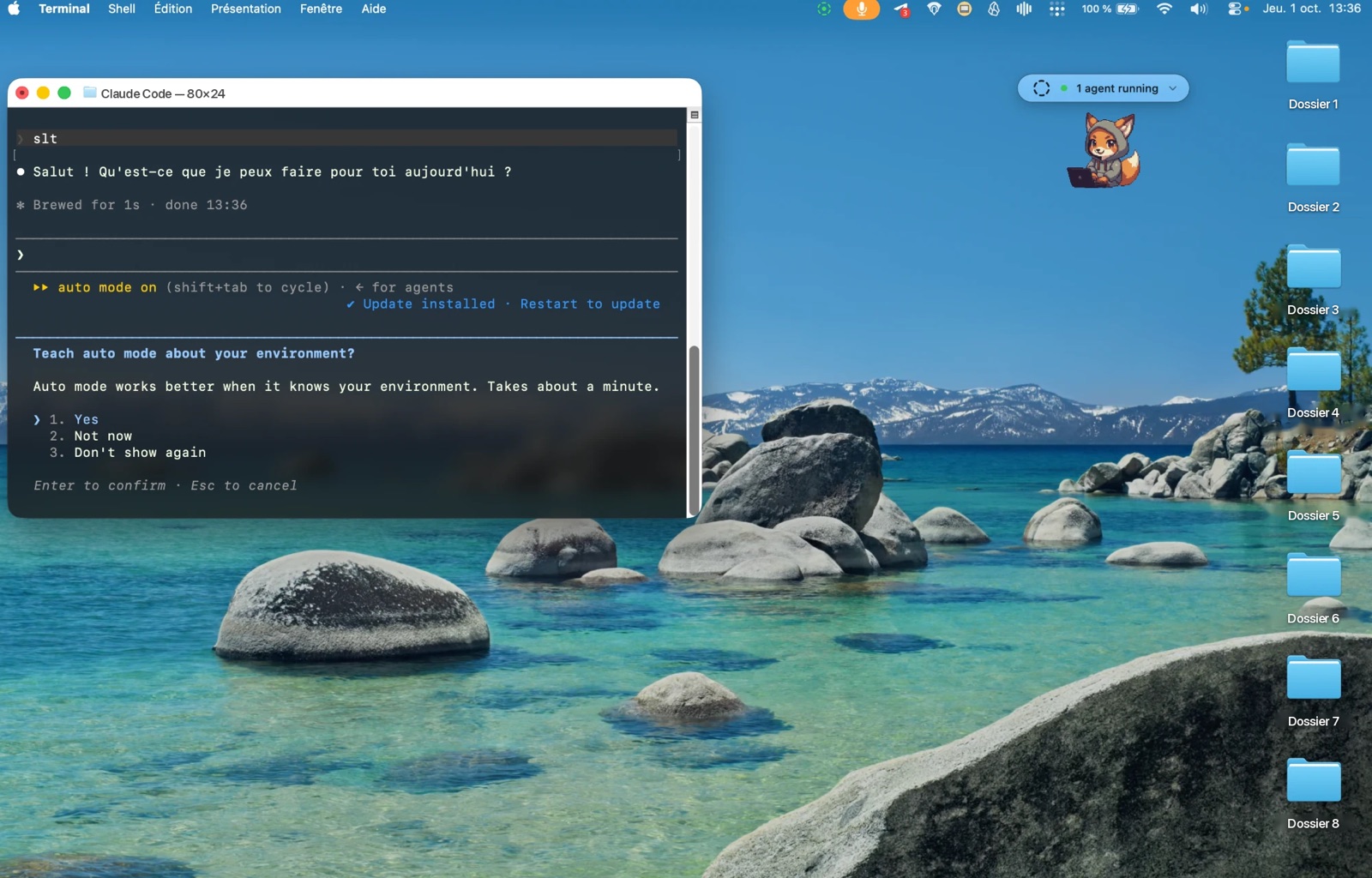
Three principles shaped it from day one:
- Private. No server, no account, no sensitive permission. Everything runs on your Mac.
- Calm. From a silent change of posture to a celebration, with a budget so it never turns into noise.
- Native and light. A real Mac app that stays under 1% CPU.
Claude Code, My Go-To
Claude Code has been my go-to tool for a long time, and it wrote most of Shiplings: about 80% of the commits are co-authored by Claude. My setup is deliberately simple. I let the context window grow to around 700k tokens before it compacts automatically, so a long session keeps the whole feature in mind, and I set reasoning to high for planning and complex tasks.
The rest is not about settings. I think of an agent as a very fast, very literal teammate who forgets everything at the end of each session. So my work moves up a level: deciding what to build, writing it down so it can't be misread, defining what "done" means, and checking the result.
That environment is what people now call the harness: everything around the model that makes its output reliable. The instructions it reads, the tools it can use, the checks it has to pass, and the limits of its autonomy.
“Claude Code wrote most of the code. My job was to build the place it works in.”
On building Shiplings
A Brief Written for Agents
Shiplings started as a product brief, long before the first line of code: who it is for, how it should feel, how each state behaves, and what it must never do.
It was written for two readers, me and the agents. The code is split into small modules, each with a single documented interface, so an agent can work on one part with minimal context. This is context engineering applied to architecture: the agent working on the GitHub connection never needs to understand the animation engine.
The brief is never rewritten. When reality proves a decision wrong, a dated note goes under the original text. It becomes a decision log that tells me the story of the product, and stops a new agent session from reviving an idea that was already dropped.
The Harness: Memory, Rules and Proof
Three layers do most of the work.
Memory
Agents start every session with a blank slate, so the project has to remember for them. At the root of the repository sits an operating manual that Claude Code reads first: how to build, how to verify a change, the product rules that are not up for debate, and the lessons from past mistakes. When something goes wrong twice, it becomes a line in that manual.
Rules that run
An instruction in a prompt is a suggestion. A failing test is a fact. So the rules that matter are enforced by automated checks: the product's tone of voice, which characters are free, how customers' settings survive an update. If an agent breaks one, the build fails and the agent corrects itself before I ever see it.
Proof
Every change comes with evidence: more than 300 checks that run anywhere, including inside an agent's sandbox, and an inspection that opens every window and fails if one comes out empty. Each pull request ends with what was verified, what wasn't, and what deserves a second opinion. An agent that says clearly what it couldn't check is far more useful than one that claims everything works.
Reality Over the Plan
Agents are very good at building what you ask for. The human part of the job is making sure that what you asked for is still true.
Several assumptions in the original brief turned out to be wrong, and the only way to know was to measure. The plan relied on a signal from Claude Code to know when an agent was waiting for the user. Across 800 tool calls, it never fired once, so detection was redesigned. Another agent's official integration never ran at all, so Shiplings reads that agent's session logs instead. A rule meant to catch stalled agents raised 47 alerts without a single real case, and was removed.
None of these were coding problems. They were product decisions, made with data, then written back into the brief so that no future session would build on the old assumption.
Parallel Work, Clear Boundaries
Once the harness was in place, work could run in parallel. A UX audit was split into five independent lots, each delivered as its own pull request and reviewed one at a time.
Parallel agents need clear boundaries, including on the human side. The project keeps a written list of what only I can do, like anything that needs my identity, a payment or an account, and of what the agent handles on its own. Knowing exactly where autonomy stops is what makes it safe to give more of it.
A Real Product, End to End
Shiplings is a full product, not a demo. It spans three repositories that never depend on one another directly, each connected to the next by a single, well-defined handover:
- the macOS app, signed, notarised and updated automatically;
- a small licence service: a payment, a key sent by email, checked offline by the app;
- a character studio that uses image and video generation models to turn a prompt into a full set of animated pixel-art sprites.
It took five days from the first commit to the first public release. Six releases followed in six weeks, and the first real customer payment went through in August.
What I Take Away
The tools will keep changing quickly. These principles, I believe, will hold, and they apply as much to a team adopting agents as to a solo project:
- Write for the agent. Specs and architecture sized for a limited context.
- Turn important rules into checks instead of repeating them in prompts.
- Ask for proof, and value an honest “not verified”.
- Keep a living decision log that agents read too.
- Decide in writing what stays human.
The model is the engine. The harness is what lets you trust where it takes you.
Shiplings is available for macOS at shiplings.app. And if you want to talk about bringing agents into your own team, my contact form goes straight to Marvin, my AI agent.
Message Marvin →🐙 Building a Personal AI Operating System
A multi-agent system around Hermes, Telegram and Obsidian, turning AI agents into a personal operating layer.